

Juices vs smoothies: which is healthier?
Learn about the similarities and differences between juices and smoothies and discover which drink is better for your health.
Juices or smoothies? That's the question here! For 40 years, the motto of Keimling Naturkost has been to encourage people to integrate more fruit and vegetables - especially in the form of raw foods - into their daily diet. After all, these foods are the real FOOD and are essential for our health and well-being.
Fruit and vegetables contain vital nutrients such as vitamins, minerals and antioxidants. They strengthen our immune system, promote heart health, support healthy weight loss and help to improve our skin. Unfortunately, most people don't get the recommended amount of fruit and vegetables in their stressful everyday lives.
This is where juices and smoothies come into play. These delicious drinks allow us to boost the nutritional content of our meals while providing our bodies with a variety of vital substances. Both juices and smoothies have their own unique properties and benefits, which we will look at in more detail.
By consuming fruit and vegetables regularly, we can benefit from an impressive nutritional content and support our health in a variety of ways. Juices and smoothies can be important pillars for integrating these valuable ingredients into our everyday lives in a simple and delicious way.
Juices: Easily digestible nutrient boosters
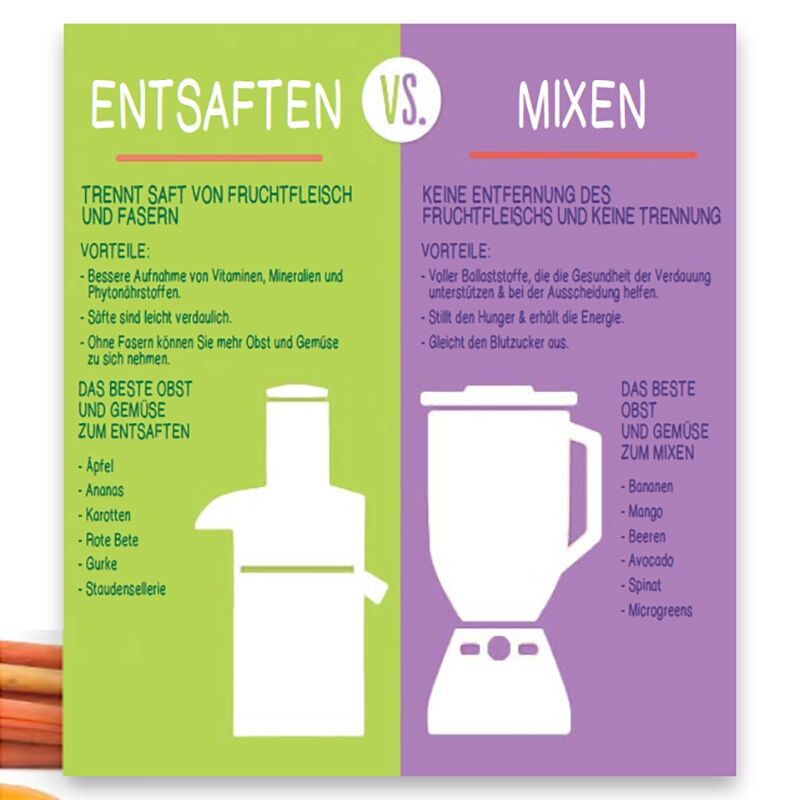
Juices are a wonderful way to enjoy the nutrients from fruit, vegetables and chlorophyll-containing foods in concentrated form. They are obtained by squeezing fresh fruit and vegetables with a juicer, separating the juice from the fibre. Fresh juices are characterised by their high nutrient density, as they contain a wealth of vitamins, minerals and antioxidants. Compared to commercially produced juices from the supermarket, which are usually not only ultra-heated, but can often also contain additives and preservatives, in this article we are talking exclusively about gently produced freshly pressed juices in raw food quality, which have been produced with a cold-press juicer, a so-called slow juicer .
Juices also have a detoxifying effect on the body. Certain juices, especially green juices, contain a variety of ingredients that can help remove toxins from the body and cleanse it. These detox properties can help boost metabolism, strengthen the immune system and improve overall health.
Depending on the ingredients chosen, juices can be used to boost the immune system, reduce inflammation, aid digestion or improve skin health. The possible combinations are almost endless and allow everyone to find fruit and vegetable juices that suit their individual goals and taste preferences.
Juices are very popular as a source of energy and should be seen as a snack rather than a meal replacement. The preparation of juices can be easily integrated into everyday life when using a good slow juicer.
In addition to freshly squeezed juices, smoothies are another way of incorporating fruit, vegetables and chlorophyll-containing foods into your daily diet in order to benefit from their health advantages.
Smoothies: the power of whole plants
Unlike juices, smoothies are prepared using all the components of the food, including the fibre and all the plant fibres. Smoothies are created when fruit and vegetables are blended in a blender to a creamy consistency. The term "smoothie" comes from the English and means smooth and soft, a pleasant to drink mixed drink.
The key difference between smoothies and juices is the fibre contained in smoothies. While juices remove the fibre from the food, smoothies retain the fibre. Fibre plays an important role in digestion and maintaining a healthy digestive system. They help to stabilise blood sugar levels, promote satiety and support healthy intestinal flora. The soluble and insoluble fibres serve as food for our good intestinal bacteria and are an elementary component of our immune system.
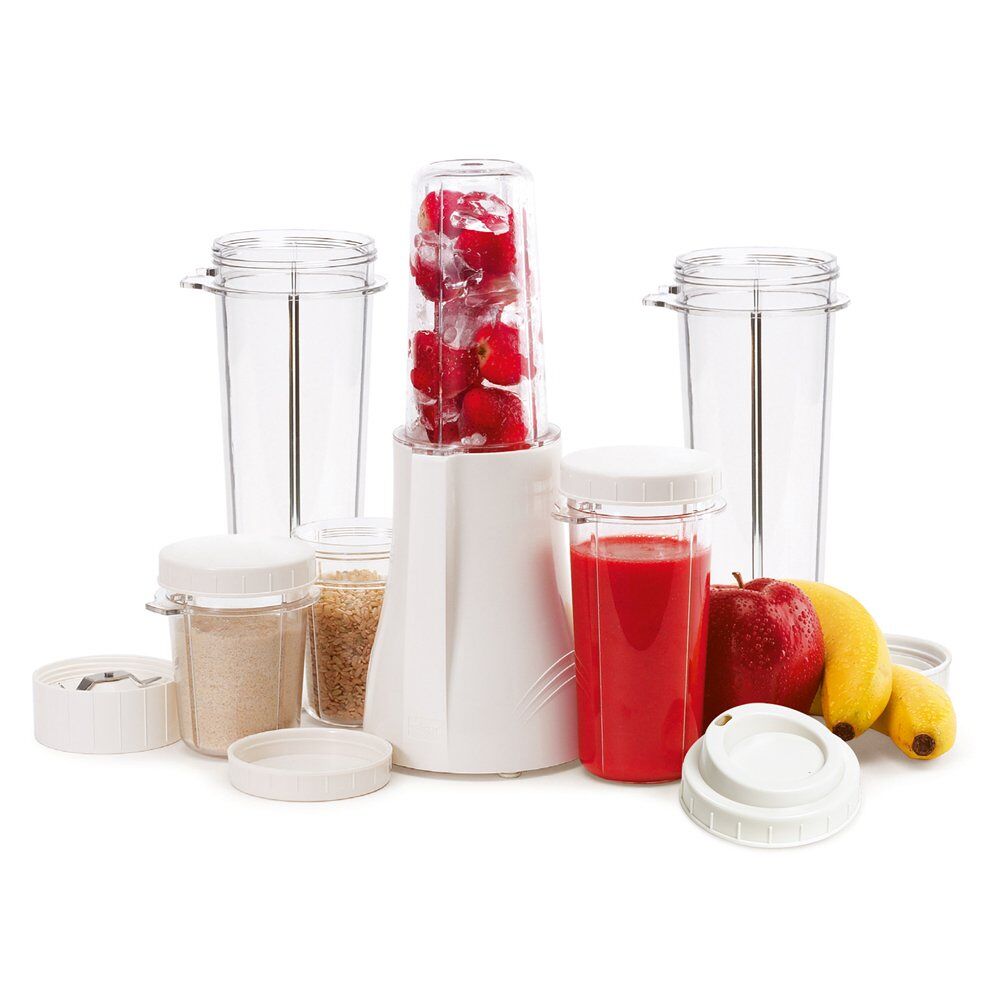
A good blender is required to prepare smoothies. If you are looking for a particularly creamy result and want to ensure that the plant fibres are effectively broken down and small seeds (such as those from strawberries or raspberries) are finely blended, you should invest in a high-performance blender. High-performance bl enders are particularly powerful blenders that have a powerful motor, special blades and a container shape that effectively guides the ingredients to the blades during the blending process. It is crucial that this is done in as little time as possible, ideally less than a minute, to avoid too much oxygen being whirled in and too much heating taking place.
Particularly popular blender brands for high-performance blenders are Vitamix and Blendtec.
Juices vs. smoothies: which is better?
There is no one-size-fits-all answer as to whether juices or smoothies are better, although this question is on many people's minds. Both drinks have their own merits, and there are several factors to consider that will help you decide.
Nutrient composition and intake
There are differences in terms of nutrient composition and absorption between juices and smoothies. Freshly squeezed raw juices are rich in concentrated nutrients. As the fibre has been removed, the nutrients in the juice can be absorbed more easily and quickly by the body. On the other hand, smoothies contain all the plant fibres, which leads to a slower absorption of nutrients and sugar. This also ensures long-lasting satiety and a continuous release of energy.
Satiety
Due to the fibre they contain and their consistency, smoothies often have a greater satiating effect and can help prevent cravings. Juices, on the other hand, can also provide a feeling of satiety due to their high nutrient content and rapid absorption of nutrients, but not as long-lasting as smoothies.
Time required and suitability for everyday use
Smoothies have a clear advantage in terms of the time required, as the ingredients generally do not need to be chopped up in the same way as with juicing. The ingredients are simply placed in the blender jug and blended for around one minute. Cleaning the container takes about a minute by running it with water for 30 seconds. A smoothie or green smoothie can usually be prepared in less than 5 minutes.
When juicing, on the other hand, the food must be prepared according to the diameter of the feed chute and then gradually inserted using the tamper. The pure juicing process takes about 5 minutes on average. If we add 5 minutes for preparation (chopping) and 5-10 minutes for cleaning, we need a total of 15-20 minutes to make 1 litre of juice (4 glasses of 250 ml each).
Smoothies are therefore easier to integrate into everyday life than juices.
Shelf life
To ensure the best flavour and the highest possible nutrient density, we recommend preparing both juices and smoothies in quantities that can be consumed immediately. If you need to squeeze or blend in advance for organisational reasons, the drinks should not be stored for longer than 24 hours to avoid excessive loss of nutrients and flavour. It is best to store them in airtight glass bottles in the fridge and choose the bottle size according to the amount of juice or smoothie to avoid trapping oxygen unnecessarily and minimise oxidation. Adding lemon juice to the juice or smoothie is helpful to maintain freshness for longer and slow down oxidation.
Slow juicers and high-performance blenders can do much more
Both blenders and juicers offer a wide range of uses beyond smoothies and juices. A high-quality blender allows you to make nut butters, soups, sauces, salad dressings, raw fruit ice cream, pesto and plant-based milk alternatives made from nuts or grains such as almond or oat milk.
In addition to juice extraction, many juicers offer additional recipe and preparation options. With the Omega MM1500 slow juicer, for example, you can make nut milk, nut butter, salsa, baby food and banana ice cream (nicecream).
There are a variety of chlorophyll-containing foods that can be integrated into juices and smoothies. Examples include green leafy vegetables such as spinach, kale and parsley, as well as herbs such as coriander and mint. Other chlorophyll-rich foods include wild herbs such as nettles and grasses such as wheatgrass and barley grass.
Incorporating chlorophyll-rich foods into juices and smoothies is simple and effective. Green leafy vegetables and herbs can be pressed or added to smoothies to boost the green power. Algae and superfoods such as spirulina can be used as powders or supplements to increase chlorophyll levels.
By regularly consuming chlorophyll-containing foods in the form of juices and green smoothies(https://www.keimling.de/magazi...), we can benefit from the numerous health benefits that these green energisers offer. Green foods also contain an above-average amount of minerals, which are particularly valuable for our bone health.
Best preparation
For optimum juice quality, use a gentle juicer (slow juicer) instead of a fast-spinning centrifugal juicer. When blending smoothies, use a high-performance blender to achieve creamier results and better breakdown of the cell fibres.
Juices and smoothies in everyday life
Make drinking juices and smoothies a healthy daily habit by integrating them into your daily routine. Replace a meal or snack with a juice or smoothie. Plan your shopping accordingly so that you always have fresh ingredients to hand. Experiment with different flavour combinations and recipes to create variety. You can also prepare your juices and smoothies and take them with you to enjoy on the go or at work.
Advantages of juices
- Easily digestible nutrient booster that relieves a weak digestive system.
- High nutrient density with vitamins, minerals and antioxidants.
- Pleasant drinking consistency without fibre and pulp.
- Detoxifying effect on the body.
- Popular as an energiser and snack.
- Easy to prepare with a high-quality slow juicer.
- Can be used to prepare other recipes such as nut butters, sauces and ice cream.
- Suitable for fasting cures without solid food (juice fasting)(https://www.keimling.de/fasten-ratgeber/)
Advantages of smoothies
- Contain all the plant fibres for healthy digestion.
- Long-lasting satiety due to the fibre.
- Lower blood sugar spikes due to gentler absorption of sugar.
- More sustainable because the whole food is used.
- Pleasant drinking consistency when using a high-performance blender.
- Easy integration of superfoods and food supplements.
- Well suited as a meal replacement.
- Less time-consuming and easier to incorporate into everyday life.
- Possibility to prepare other recipes such as soups, sauces, nut butters and nut milks.
Our conclusion
Regular consumption of fruit, vegetables and chlorophyll-containing foods is of great importance for our health and vitality. Both juices and smoothies offer us an easy and delicious way to incorporate these valuable nutrients into our diet. Juices provide us with concentrated nutrients and allow for quick absorption, while smoothies retain the fibre and whole plant fibre, resulting in long-lasting satiety and energy.
The choice between juices and smoothies depends on individual preferences and needs. Both options offer a wide range of health benefits, from boosting the immune system and supporting heart health to promoting healthy weight loss and improving skin health. We recommend incorporating both juices and smoothies into your daily diet to reap the benefits of each.
Smoothies and juices allow us to easily increase our daily intake of fruit and vegetables and support our health in the long term.
We hope that this article has whetted your appetite for a portion of freshly prepared health from a glass, whether you prefer juices or smoothies!
Related products

Available, delivery time: 1-3 days