

Algae - what can they do!
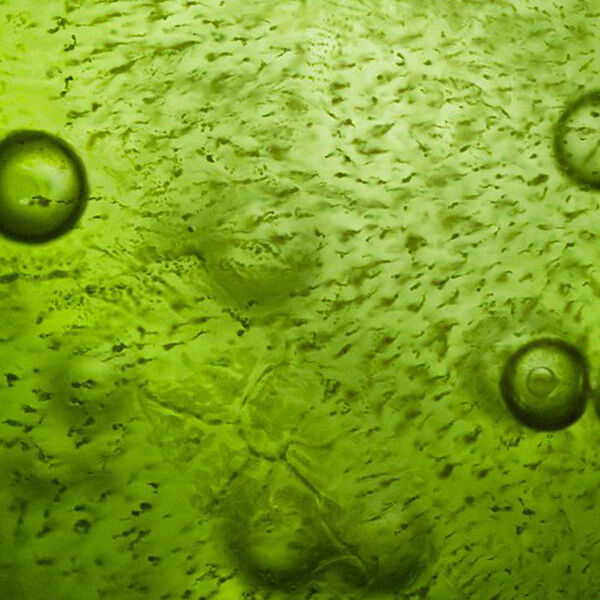
Discover the fascinating world of algae! From oxygen production to food sources - find out more about their versatility and nutrients.
Did you know that ...
- half of the oxygen on earth was produced by algae?
- algae are a staple food in coastal regions?
- algae grow 10 to 30 times faster than land plants?
- Algae are therefore a beacon of hope for supplying the growing population with nutrients?
- More than 100 species of algae are used as food or raw materials?
Differentiation of algae
A basic distinction is made between microalgae and macroalgae. Microalgae cannot be seen individually with the naked eye, rather by a discolouration of the water. Macroalgae, on the other hand, can grow as large as carpets. Both occur in fresh and salt water, i.e. in seas. This is a second way of distinguishing whether they grow naturally in lakes (fresh water) or in seas (salt water).
The microalgae spirulina, chlorella and AFA (Aphanizomenon flos-aquae) are often taken as food supplements, Schizochytrium sp. is a popular source of plant-based omega-3, i.e. the important fatty acids EPA and DHA. You may also have read the name Lithothamnium calcareum. This algae is often added to various food supplements due to its mineral richness, e.g. our Spirulina + Calcium tablets.
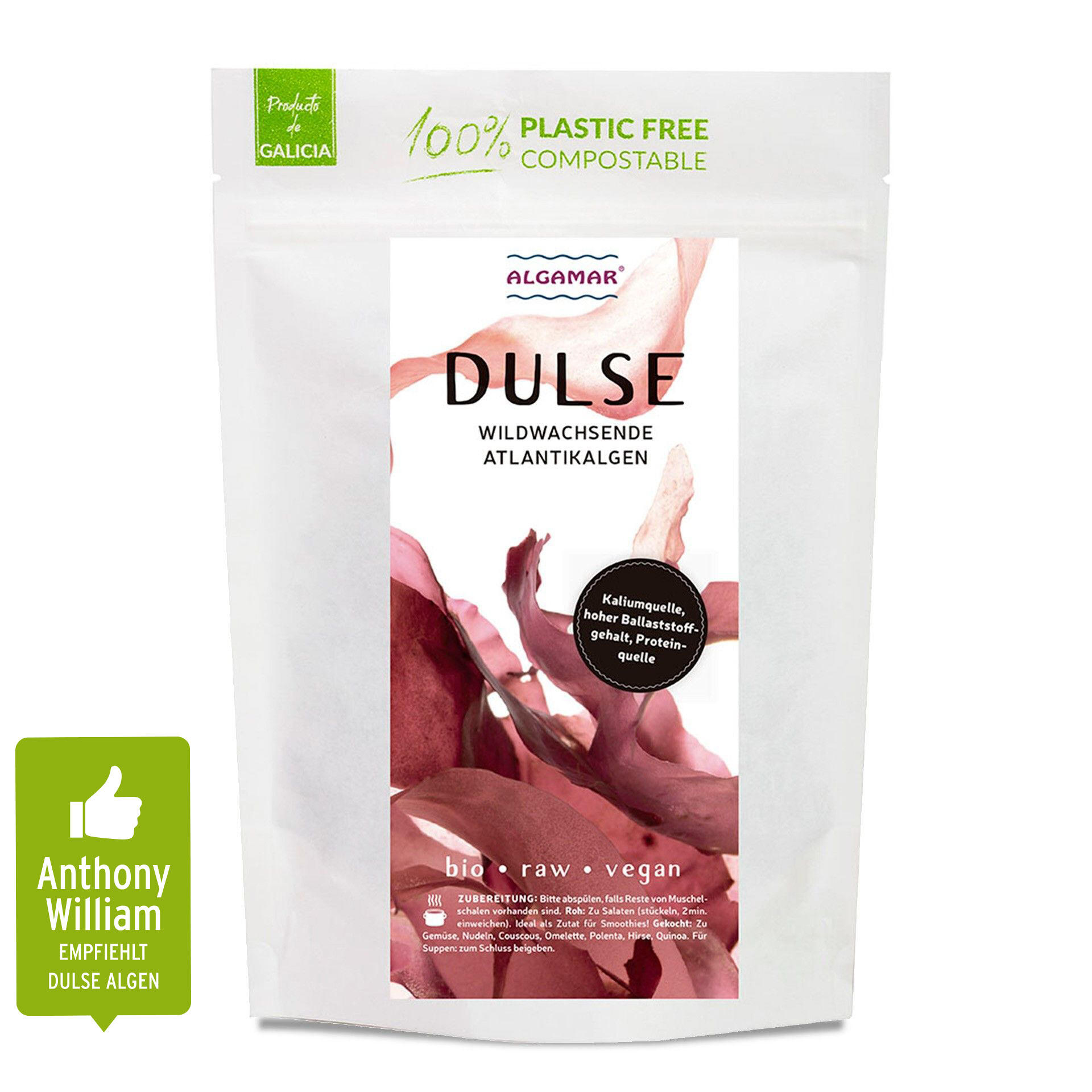
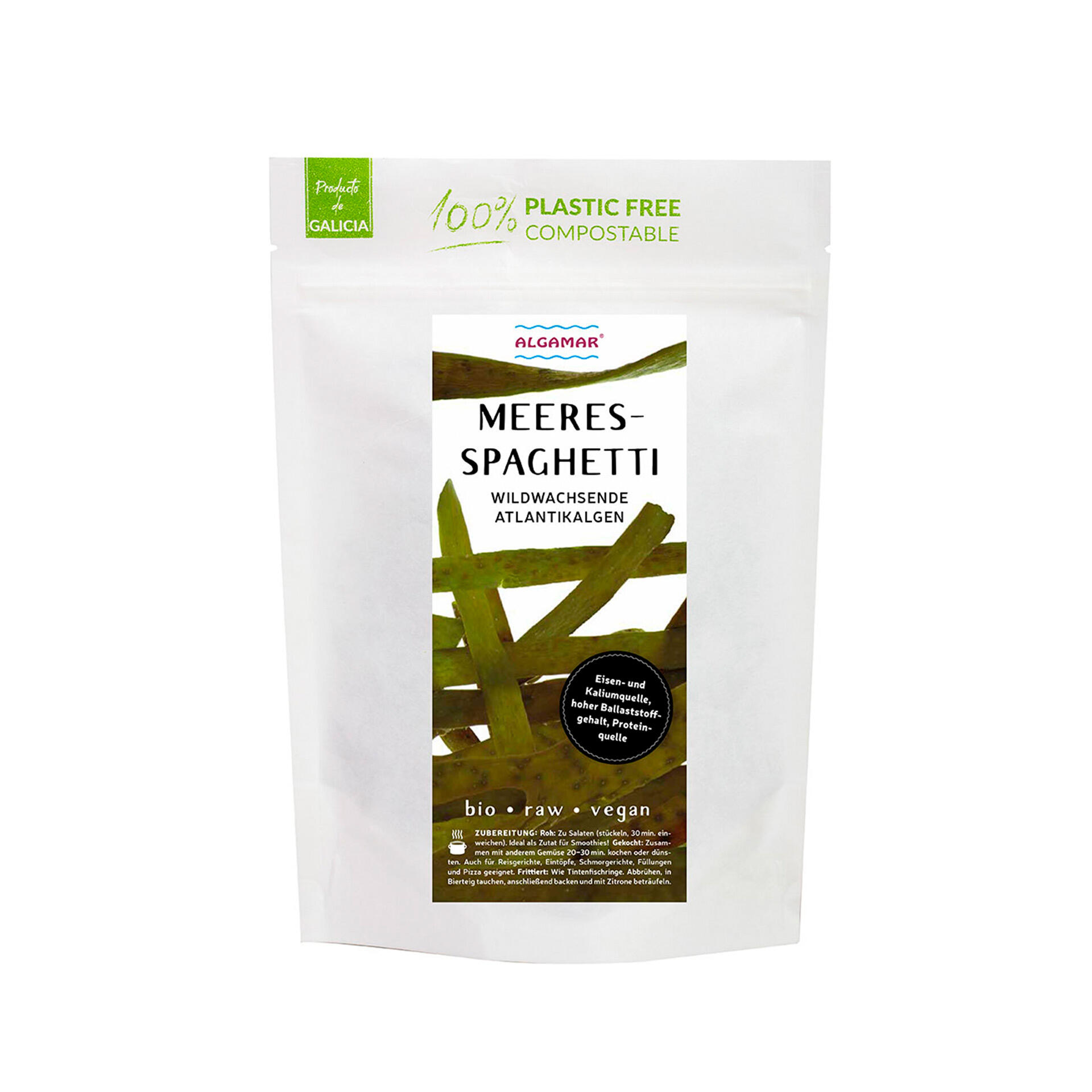
When it comes to macroalgae, there are a few "starter algae" that are easy to process and have a pleasant flavour for most people. These include dulse, sea spaghetti, Irish moss (a great gelatine substitute in the kitchen) and wakame.
You can find these algae in our "Algae" section, which belongs to the "Food supplements" category. For each algae we also have some suggestions on how you can use it in the best and tastiest way. There are also downloadable recipes for sea spaghetti and wakame.
Important tips for use in the kitchen:
Dried seaweed has a very salty flavour. This means that they can be used as a seasoning in dried form, but you can also remove a large proportion of the salt by soaking or rinsing them. For many purposes, such as adding to vegetables, salads, soups or smoothies, the soaked seaweed is used anyway.
Be careful with the dosage: 1. because of the iodine content of the seaweed (see "Iodine" below), 2. they swell up very much when soaked, you then have many times the amount of dry seaweed.
A matter of taste
As you can see, there are many ways to use and prepare seaweed. With different algae products and a selection of recipes, algae can become a delicious, permanent part of the kitchen.
Classic dishes such as the bright green wakame salad or vegan sushi are ideal as starter dishes. Sea spaghetti with a plant-based "Bolognese" sauce is quick to prepare and an insider tip in terms of flavour.
Nutritional values of seaweed
The nutrients algae have to offer are extremely exciting and they can support many diets. Algae have virtually no fat, no sugar and few carbohydrates. Where they really come up trumps is in fibre (up to 34 g/100 g dried algae), minerals and carotenoids. Chlorella (over 55%) and spirulina (60 - 70%) are high in protein. Even if you only use small amounts of these algae (see recommended intake), this will help to cover your protein requirements (approx. 5 g). As all the essential amino acids are included, the protein can also be easily utilised by the body.
Spirulina, chlorella, sea spaghetti and dulse are very good if you want to optimise your iron supply.
Chlorella is the only plant that can produce vitamin B12 that we can use, and in really large quantities - one portion (5 tablets = 7.5 g) has five times the daily requirement of vitamin B12.
Most algae are also rich in potassium.
Wakame algae also provide a good amount of calcium and magnesium, magnesium is also present in higher quantities in dulse and Irish moss shines with extra copper.
What perhaps few people expect: Dulse algae even provide vitamin C.
Algae (except Irish moss) also contain more or less chlorophyll, a very interesting substance that is currently being researched by scientists. Chlorella is clearly the frontrunner here.
What makes algae almost unique is the range of minerals and trace elements. Marine algae in particular absorb and concentrate the many different elements in seawater. Therefore, every algae is a perfect food supplement.
Iodine - well supplied or not?
Some people assume that iodine is present in every algae and is therefore the characteristic feature of algae. As there are freshwater algae as well as saltwater algae, this is not the case. You may have already used the three well-known freshwater algae spirulina, chlorella and AFA: they all contain no or only marginal amounts of iodine.
Seaweeds such as Irish moss, dulse, sea spaghetti and wakame, on the other hand, have high to very high levels of iodine. Pay attention to the information for each algae. To avoid ingesting too much iodine, each algae is labelled with the maximum daily intake. In the case of algae with a high iodine content, this is only a few grams, which, however, looks like a lot more on the spoon than you previously thought. Especially when they have been soaked and then multiplied in volume.
Iodine is a vital trace element and so the supply of iodine should be given a certain amount of attention. Although only 180 to 200 micrograms per day are needed, even this is rarely achieved with a normal diet.
Iodine supply in Germany:
Without the use of iodised table salt, 96% of men and 97% of women are below the recommendation for iodine intake (National Consumption Study II). Assuming that all salt used in the household is iodised salt and that the products purchased contain iodised table salt, 28% of men and 53% of women are still below the recommended daily requirement. Since the truth lies somewhere in between, at least one in two people are likely to have an iodine deficiency.
Detox
Have you noticed that the "Heavy Metal Smoothie Set according to A. William" contains two algae? Anthony William specifically recommends the use of dulse and spirulina for this combination. The name of the set clearly indicates what the body is being cleansed of. The set with blueberry powder contains almost all the ingredients for the Heavy Metal Detox Smoothie - you can only add fresh coriander and fruit or juice.
Heavy Metal Smoothie Set according to A. William
Conclusion
There are 'umpteen reasons to venture into the wonderful world of algae. We have only hinted at the variety, their nutritional values and their benefits for our health. There is much more to algae.
Which algae(s) will you choose the next time you shop at Keimling choose?
Sources:
Final Report National Nutrition Survey II, Part 2 - https://www.mri.bund.de/filead...
DGE reference values for iodine - https://www.dge.de/wissenschaft/referenzwerte/jod/
REGULATION (EC) No 1924/2006 OF THE EUROPEAN PARLIAMENT AND OF THE COUNCIL of 20 December 2006 December 2006 on nutrition and health claims made on foods - https://eur-lex.europa.eu/lega...
Protein source = 12% of the total kcal
high protein content = 20% of total kcal
Protein-calorie limits
| Name | kcal | Protein | 1. limit 12% | 2. Limit 20% |
|---|---|---|---|---|
| Sea spaghetti | 222 | 8,5 | 26.6 / 34 egg kcal | 44,4 / 34 |
| Dulse | 255 | 18,1 | 30,6 / 72 | 51 / 72 |
| Irish moss | 50 | 8,3 | 6 / 33,2 | 10 / 33,2 |
| Wakame | 195 | 12,6 | 23,4 / 50,4 | 39 / 50,4 |
Related products
Available, delivery time: 1-3 days

Available, delivery time: 1-3 days
Available, delivery time: 1-3 days