

Roland Jentschura on alkaline, healthy, successful sport and why more and more people are currently falling by the wayside.

In this blog post, the author of "Power instead of 'sour'" gives us a concise insight into the mostly avoidable causes and consequences of chronic latent hyperacidity as well as how to prevent and regenerate it.
Text and images: www.p-jentschura.com
Attention: Sport is unhealthy!
Yes, you read that right: Sport is unhealthy! Very few people realise this! Because in addition to calories, sport also consumes vitamins, secondary plant substances such as antioxidants, minerals and therefore valuable bases. Protein and protein structures are also used up or destroyed, and not just in the case of sore muscles (micro-injuries), bruises, contusions etc. Millions of blood cells are crushed during jogging. The immune system goes into the cellar. Last but not least, intensive sport acidifies the body and its connective tissue with carbon, milk, vinegar, urine and other acidic metabolic end products.
But before you misunderstand me: This is exactly right and important!
Paradox: because sport is unhealthy, it is healthy!
This is because sport provides us with the constant "stimuli" required for regeneration. Without regular training, our strength, stability, functionality, resilience and ultimately the entire tissue will deteriorate as quickly as a "plaster leg", of which only half is left after a few weeks. Physical exertion starts our body's own programmes for regeneration, improved blood circulation and the entire cardiovascular system as well as for firm connective tissue and strong muscles, tendons, ligaments, cartilage, intervertebral discs and joints. However, the regeneration programmes are only started through sport. Whether these programmes are successful is determined by the acid-base balance.
The acid-base balance decides!
Currently, more and more athletes remain "permanently sour", injured and worn out because they are chronically over-acidified. This is due in particular to the combination of sport with a lack of exercise ("Sitting is the new smoking!") and today's "normal" diet, which is low in alkaline, vital substances and fibre but high in acids and harmful substances.
A chronic excess of acids then acts like "sand in the gears" in the body! Acids directly reduce performance and the acidic muscle closes down more and more frequently. Acids promote pain and inflammation via acid-sensitive receptors. Acids burden the excretory organs and promote skin problems. Acids weaken the tissues, especially as the vital substances for regeneration are not supplied to the body. Acids increase wear and tear and accelerate the ageing process.
Below pH 7.2, for example, the bone-cleaving osteoclasts are activated to release calcium and phosphate for acid buffering, as our blood in particular must always remain in the slightly alkaline range between pH 7.35 - 7.45 in order to be able to flow. An absolutely sensible mechanism, unfortunately with the consequence of athletic fatigue fractures and osteoporosis - despite training. And just like the bones, the scalp, teeth, connective tissue, cartilage, intervertebral discs etc. are also demineralised in the event of chronic latent hyperacidity.
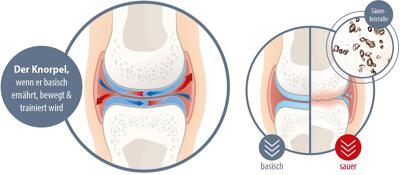
Our joints in particular tend to degenerate nowadays, as they are not supplied with blood and a lack of exercise and a poor diet can quickly cause the pH levels there to drop and the acids to crystallise, resulting in pain, inflammation, arthritis, arthrosis, gout, etc. Gout, i.e. the painful crystallisation of uric acid, is one of the so-called waste products. The generic term "slag" perfectly describes the metabolism and the diseases of civilisation due to chronic latent hyperacidity, in which acids and harmful substances are pathologically deposited in the body: in the visceral abdominal fat and in the problem areas, as kidney, bladder and gallstones, as arteriosclerosis, cataracts, etc.
First an "oil change", then sport
If you have "sand in your gearbox", you should have an "oil change". Dr h. c. Peter Jentschura first researched this as the "triple jump of purification and regeneration". It has proven itself in practice for over 30 years:
In the first step, the acids and harmful substances deposited in the waste products are dissolved out again. This is done using a special tea, in line with the centuries-old saying: "There's a herb for everything." In the second step, the acids and harmful substances reactivated from the waste products must be neutralised by our body's own buffer systems and organs, removed and, if possible, excreted. In addition, the previously demineralised tissues must be regenerated. Both require vital substances such as minerals, vitamins, secondary plant substances, etc. Plants, with their gigantic variety of bioavailable vital substances, are irreplaceable for this. However, every plant has typical ingredients, so we need a very varied diet in order to be fully nourished. We need all of nature's minerals, all vitamins and all of the 5,000 to 10,000 secondary plant substances relevant to our metabolism in natural balances. This also optimises our metabolism, with all its organs and functions, and the immune system with its approximately 50,000 different enzymes, which are active in the billions and require almost all vitamins as co-enzymes and minerals as co-factors in order to function. "You are what you eat!" is more important today than ever!
Thirdly, the acids must be excreted. They have only accumulated because the liver, kidneys, intestines, lungs, lymph and skin were obviously overwhelmed. A diet rich in vital substances optimises the internal organs. Alkaline body care has proven its worth in deacidifying the skin for decades. Alkaline body care is the most natural body care anyway - we all took alkaline baths for nine months - in our mother's womb and were born with the most beautiful baby skin. Without intervening, alkaline body care simply frees the skin from the acids that have already been excreted. A simple foot bath after a long day and especially after sport activates 90,000 sweat glands.
So stay alkaline, your Roland
You can find the jentschura range at Keimling Naturkost here.
Related products

Available, delivery time: 1-3 days