

Raw food trends and their pioneers
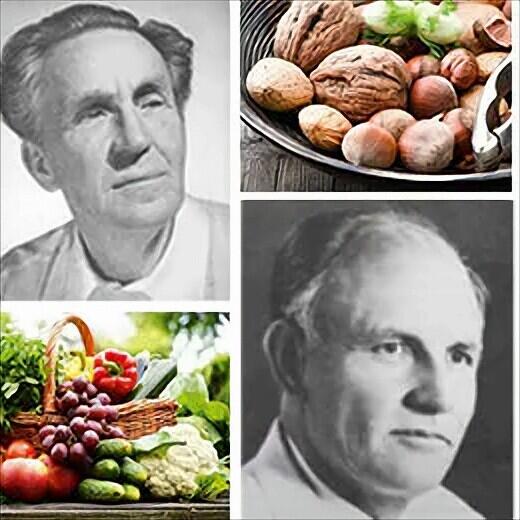
Raw food is as diverse as its followers. There is no "one" direction. Rather, very different schools have emerged over the course of time.
What are the different types of raw food?
Some are vegan, others allow meat. Some don't have their first meal until lunchtime, others only eat fruit.
However, all raw food diets have one thing in common: unheated and unprocessed food as the basis of a healthy diet.
We have compiled the best-known nutritional teachings for you - without claiming to be exhaustive. This is because this topic is subject to dynamic change.
What is once written down is interpreted, modified and reinvented. New trends develop from individual needs. This is also what makes raw food so varied and exciting!
Original diet according to Franz Konz
Urkost is a nutritional theory founded by Franz Konz that focusses on native wild plants. Leaves, berries and fruit are eaten raw and in their natural state. The food is not rinsed before consumption. As a result, small insects or worms occasionally end up in the stomach with this vegan diet.
Franz Konz was one of the first to recognise and promote the importance of chlorophyll-containing foods in a raw food diet. In 1996, he published his almost 1500-page nutrition guide "Der Große Gesundheits-Konz" (The Great Health Konz), in which he imparts his raw food teachings.
Part of the concept of the Urkost school is the view that additional fluid intake is superfluous. According to Konz, anyone who eats a primal diet in accordance with his guidelines takes in enough liquid through their food and does not need to drink.
Sun food according to Helmut Wandmaker
The sun diet is a vegan nutritional concept. Fresh fruit is considered a first-class food and makes up the majority of the diet. Vegetables only belong on the menu in small quantities, as do nuts. Wild herbs are completely excluded.
The basic idea behind the sun diet is that humans only do not interfere with nature when eating fruit. Animals are killed for their meat and vegetables have to be replanted after harvesting. Fruit trees and berry bushes, on the other hand, bear fruit again after the harvest.
Helmut Wandmaker, the founder of the sun diet, describes fruit as nature's "fast food". When eating mainly fruit, the body needs significantly less time for digestion and can look after itself again more quickly.
The sun diet doctrine recommends distilled water as a drink. The concept also involves spending a lot of time in the fresh air and sunshine and strengthening your body with sufficient exercise.
Evers diet according to Dr Joseph Evers
The Evers diet is a mainly raw food diet founded by the German physician Dr Joseph Evers. The basic idea behind it is that industrially processed foods are causing many diseases of civilisation.
In general, it is important to eat raw, natural foods wherever possible. This includes fruit, vegetables, whole grains, fruit and roots. Wholemeal bread and raw milk butter are also permitted.
Raw or lightly fried meat, raw fish, raw ham, nuts and sprouts can also be eaten. Water is drunk. Potatoes and raw leafy vegetables are taboo.
The Evers diet concept also includes a healthy lifestyle. A healthy diet also includes sufficient exercise in the fresh air. Kneipp treatments are also recommended.
Schnitzer diet according to Johann Georg Schnitzer
The Schnitzer diet is a raw food variant invented by the German dentist Johann Georg Schnitzer. To prevent various diseases, it is recommended to eat mainly cereals, pulses, root vegetables, nuts, seeds and green salads.
According to the Schnitzer diet theory, cooked and highly processed food is the main cause of chronic civilisation diseases. All food consumed should come from controlled organic cultivation wherever possible. Meat is considered an unsuitable food. Permitted drinks are spring water, table water and tea.
The Schnitzer diet comprises two types of food: the Schnitzer intensive diet and the Schnitzer normal diet. The Schnitzer Intensive Diet is a purely vegan, low-protein raw diet. The typical daily routine in the Schnitzer Intensive Diet begins with a breakfast of fresh grain porridge and apple. For lunch and dinner, there are salads made from leafy and root vegetables.
The Schnitzer normal diet is an ovo-lacto-vegetarian diet. It mainly contains cereals and seeds that are freshly ground before consumption. In addition to nuts, salad and fruit, it also includes potatoes, rice, wholemeal and egg products.
Although the Schnitzer diet considers milk and dairy products to be unsuitable for the diet, these are permitted in the normal diet variant.
Primal Diet according to Aajonus Vonderplanitz
The Primal Diet is a form of raw food nutrition that belongs to the Palaeolithic forms of nutrition. The idea behind it is that humans are not adapted to modern diets and should return as far as possible to the diet of their early ancestors. The inventor of the Primal Diet is Aajonus Vonderplanitz.
According to the Primal Diet, a raw, non-vegetarian diet with few carbohydrates is optimal for the human organism. Raw meat, raw milk, raw dairy products and freshly squeezed vegetable juices are served.
Natural health teachings (Natural Hygiene)
The best-known representative of the Natural Hygiene movement was the American Herbert M. Shelton. This doctrine is often attributed to him alone, but in fact the natural health doctrine originated from a movement of doctors.
Around 1822, a number of doctors came together who were critical of treatment with medication and no longer saw any health benefits for people.
The basic idea of the Natural Health Theory is that people can lead a physically, mentally and emotionally healthy life. To achieve this, they must orientate themselves on the eating habits of their ancestors, cultivate loving social relationships, pursue a satisfying profession, maintain a balanced alternation of waking and sleeping, and integrate cleanliness and sufficient sunshine, pure water and fresh air into their lives.
Shelton recommends a purely plant-based diet, while other hygienists also recommend animal-based foods that are mainly eaten raw. The Natural Hygiene movement offers three diets, as it is not known exactly how our early ancestors ate:
Palaeolithic or Stone Age diet: mainly animal foods (only partially raw), salads and green juices are consumed. Fruit was eaten at most once a day.
Instinctive diet: Here, mainly plant-based foods are eaten. Animal foods are eaten at most once a day and then mainly raw. The food is chosen instinctively.
Ovo-lacto-vegetarian diet: In this variant, animal foods are consumed in the form of milk and eggs. However, the majority of the diet consists of raw plant foods.
In addition to Herbert M. Shelton, the founders of the Natural Hygiene movement include Prof. Arnold Ehret, Dr Norman. W. Walker, Dr Paul C. Bragg and Dr John H. Tilden. In the 1980s, Helmut Wandmaker, the founder of the Sun Diet, brought the ideas of Natural Hygiene to Germany. Franz Konz also incorporated the ideas of Natural Hygiene into his original diet.
Fit for life according to Harvey and Marilyn Diamond
Fit for Life is the name of a school of nutrition that was published in 1985 in the book of the same name by Harvey and Marilyn Diamond. It is a food combining diet based on raw food, which goes back to the theories of the US American Natural Hygiene movement of the 19th century.
In the Fit for Life model, 70% of the dietary requirement is covered by fruit, vegetables and salads. The remaining 30% is made up of bread, cereals and meat. Meat is therefore not generally taboo, but should only end up on the plate very rarely. Distilled water and freshly squeezed fruit and vegetable juice are available to drink.
The Fit for Life principle divides the nutritional cycle into three phases: From 4 a.m. to 12 a.m., the body is busy with elimination work. Food intake takes place from 12 noon to 8 pm and the body digests and utilises food from 8 pm to 4 am.
According to the Fit for Life doctrine, fruit should always be eaten on an empty stomach and not combined with other foods. The first meal of the day therefore consists of fruit and freshly squeezed juices. Salads and vegetables are served for lunch. Meat, potatoes and vegetables are allowed in the evening.
80/10/10 Diet according to Dr Douglas N. Graham
Dr Douglas N. Graham added a new aspect to the raw vegan diet with his book "The 80/10/10 Diet", first published in 2006: lifestyle! Although he didn't reinvent the wheel, he at least gave the raw food movement a hip twist.
The philosophy of "high carb - low fat" is at the centre of this raw vegan doctrine. 80/10/10 refers to the distribution of calories: 80% are derived from carbohydrates, 10% from protein and 10% from fat. Conveniently, most fruit and vegetables have roughly this distribution.
If you eat according to the 80/10/10 method, you get your carbohydrates almost exclusively from ripe fruit. Large quantities of salad and vegetables are also on the menu and provide chlorophyll and minerals. According to Graham, all food should be organically grown.
Graham's 80/10/10 diet is not a static framework. Rather, it should be seen as a guideline. The calories obtained from carbohydrates may sometimes exceed the 80% proportion. In return, the proportion of protein and fat is reduced. Caution is advised with avocados and nuts, as they have a high fat content. They should therefore only be consumed in small quantities.
Bircher-Benner diet according to Dr Maximilian Oskar Bircher-Benner
Oat flakes, a grated apple, lemon juice, sweetened condensed milk and grated nuts: This is the original Bircher muesli from the Swiss doctor Dr Maximilian Oskar Bircher-Benner. This muesli, which is served in many variations today, is part of a wholesome vegetarian diet with a high raw food content. In addition to raw vegetables, fruit and salad, it also includes gently cooked cereals and vegetables as well as the moderate consumption of milk, butter, cheese and eggs.
According to Bircher-Benner, plants are of particular nutritional and physiological importance as they obtain their energy from sunlight. According to Bircher-Benner, "sunlight nutrition", which consists primarily of fresh and raw foods, is of outstanding value for human health.
The Bircher-Benner theory is a holistic concept. In addition to a healthy diet, it also includes other factors that influence quality of life. These include a balanced wake-sleep rhythm, a harmonious work-life balance, a well thought-out and actively organised lifestyle, uplifting social contacts and plenty of exercise in the fresh air.
Cooked, highly processed and preserved foods, sugar, processed flours and meat and sausages are not permitted in the Bircher-Benner diet. Water, freshly squeezed juices and herbal teas are permitted.
Wholefood diet rich in vital substances according to Dr. Max Otto Bruker
The model of a wholefood diet rich in vital substances is based on the nutritional recommendations of the German physician Dr Max Otto Bruker. The wholefood diet is based on the principle of consuming food in its natural form wherever possible. Wholefood nutrition includes cereals, wholemeal bread, raw fruit and vegetables as well as natural fats - including butter and cream. Fresh grain porridge plays a special role.
Bruker's wholefood diet, which is rich in vital nutrients, is primarily based on the teachings of the Swiss doctor Maximilian Bircher-Benner and Werner Kollath. All three were concerned with the connection between nutrition and the so-called diseases of civilisation.
The school of wholefood nutrition, which is rich in vital substances, considers its diet to be ideal for the human organism due to its naturalness. Wholesome and largely natural foods are at the centre of this doctrine. Meat products, eggs and fish should be avoided as far as possible. Fruit juices are rejected as valuable organic ingredients remain in the pomace.
Giessen concept of wholefood nutrition
The Giessen concept of wholefood nutrition has its origins in the 1980s. It was developed by three nutritionists at the University of Giessen: Dr Karl von Koerber, Prof Claus Leitzmann and Thomas Männle.
These gentlemen define their wholefood diet as predominantly plant-based (lacto-vegetable). Fruit and vegetables, wholemeal products, potatoes and pulses as well as milk and dairy products are minimally processed and prepared into tasty, easily digestible meals. Meat, fish and eggs may also be consumed in small quantities. About half of the diet should consist of fresh raw vegetables.
In addition to a healthy and varied diet, sustainability factors also play a role in the Giessen concept of wholefood nutrition. Food should come from organic farming. Regional and seasonal products are also favoured, and attention is paid to the environmental compatibility of packaging and support for fair trade.
Wholesome nutrition according to the Giessen concept is not only aimed at improving one's own quality of life. Rather, it is a holistic concept that also includes the careful treatment of the environment, social justice and fair economic relations.
Waerland diet according to Are Waerland
The Waerland diet is an ovo-lacto-vegetarian diet. In addition to vegetables and wholemeal cereals, it also allows the consumption of milk and dairy products. It was developed at the beginning of the 20th century. It was invented by the Swede Are Waerland at the end of the 19th century.
The diet mainly consists of raw food. Boiled potatoes with skin and a wholemeal cereal porridge called "Kruska" are also eaten. Milk, quark, butter, sour milk and cheese are permitted. Meat, fish and eggs should be avoided, as should table salt and hot spices.
A typical day on the Waerland diet begins with a breakfast of soured milk and fresh fruit. At lunchtime there are raw vegetables, wholemeal bread, jacket potatoes, quark and cheese and in the evening the cereal porridge "Kruska". It is also possible to swap lunch and dinner.
The Waerland-Köstler drinks half a litre of potato water before breakfast. Potatoes are cooked in this water with the skin on and without salt. The Waerland drink "Excelsior" is also possible. This also consists of potato water in which celery root and carrots have also been boiled. Two tablespoons each of wheat bran and linseed are soaked in both drinks the evening before. The mixture is drunk lukewarm on an empty stomach.
Fresh vegetable juices and milk are also permitted. Throughout the day, the Waerland-Köstler consumes 3 to 3.5 litres of liquid, which are drunk between meals.
We have compiled the following nutritional concepts for information purposes. They serve as a comprehensive presentation of different points of view, but do not reflect the opinion of Keimling Naturkost.